Ashwagandha continues to face regulatory scrutiny in Europe, highlighting the need for high-quality safety data generated using internationally recognised standards.
A recent OECD- and GLP-compliant safety assessment of a fully characterised root-and-leaf ashwagandha extract demonstrated no genotoxicity, no treatment-related adverse effects in a 90-day study, normal liver findings and no adverse endocrine effects, even at exposure levels substantially above typical consumer use1.
These findings are consistent with published clinical studies showing standardised ashwagandha extracts to be generally well tolerated and provide an important evidence base for future regulatory evaluations.
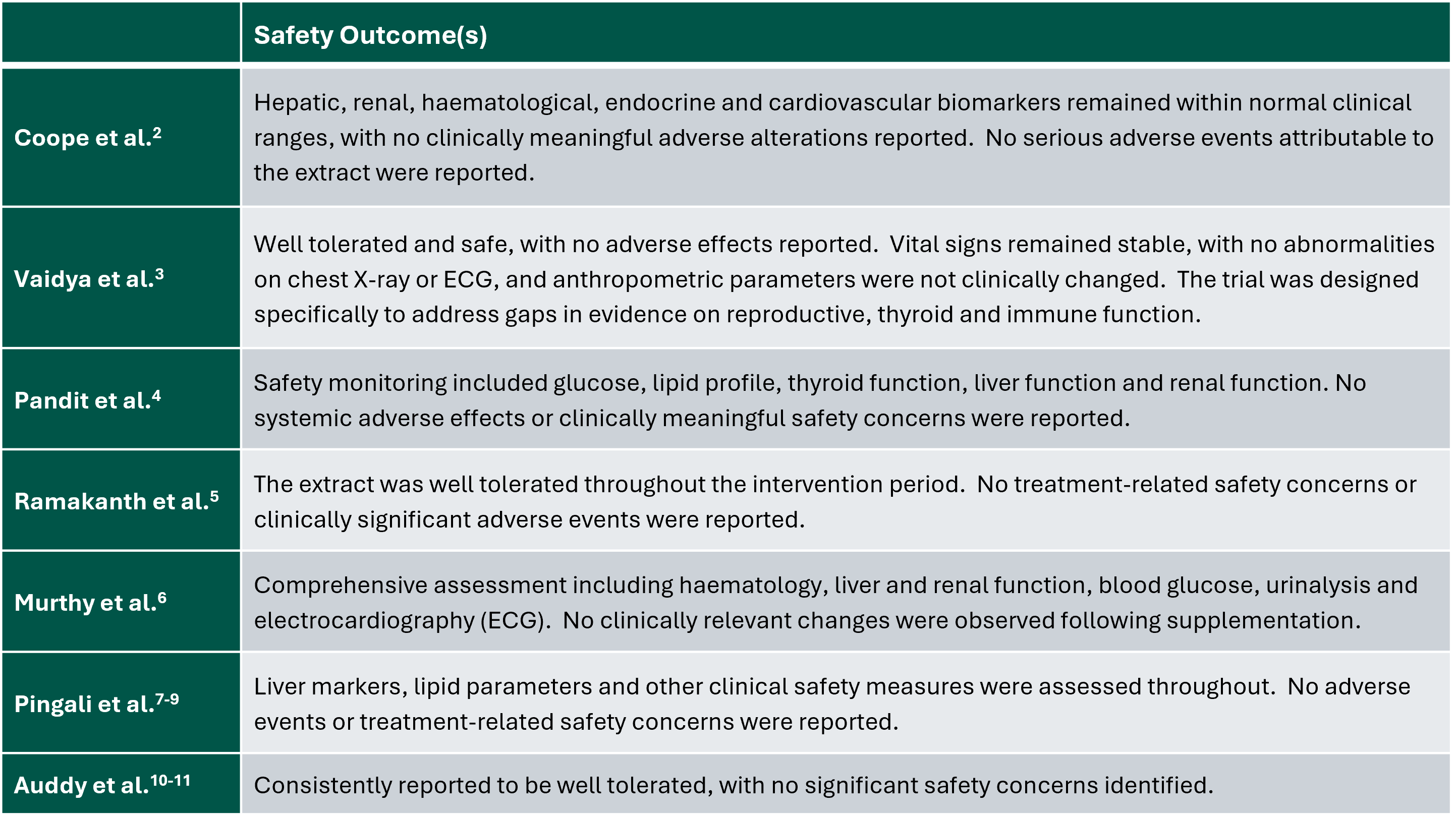
Standardised ashwagandha extracts have been evaluated for safety and tolerability in a range of human clinical studies, some of which are summarised in Table 1. Over the past decade, however, ashwagandha has come under increasing regulatory pressure across Europe.
Table 1. Safety and Tolerability Evaluations of Standardised Ashwagandha Extracts
In recent years, several EU member states have introduced or proposed measures affecting its use in food supplements, ranging from limits on daily intake to reclassification and, in some cases, national restrictions; others continue to keep it under review.
These differing national positions reflect an evolving and, in places, contested regulatory picture rather than a settled EU-wide consensus.
In June 2024, the EU Heads of Food Safety Agencies recommended initiating a formal review procedure that could result in no regulatory action, an EU-wide restriction or prohibition12.
A central and recurring issue throughout this regulatory debate has been the limited availability of publicly accessible toxicology datasets generated to internationally recognised testing standards, contributing to differing interpretations across jurisdictions.
In 2026, Summan et al.1 addressed that gap by providing a comprehensive safety evaluation of a standardised ashwagandha root-and-leaf extract, conducted in accordance with Organisation for Economic Co-operation and Development (OECD) Test Guidelines and Good Laboratory Practice (GLP), and published in peer-reviewed literature.
Why do OECD and GLP Matter?
Not all safety studies are conducted to the same standard.
OECD Test Guidelines provide internationally recognised methods that allow safety data to be evaluated consistently by regulators around the world. GLP ensures that studies are planned, conducted, recorded and audited according to strict quality standards.
OECD Test Guidelines — a standardised method
- OECD Test Guidelines are internationally recognised study designs. Because every laboratory follows the same protocol, results generated in one country can be evaluated consistently by regulators anywhere in the world.
GLP-certified conduct — audited quality control
- GLP (Good Laboratory Practice) means the study was planned, conducted, recorded and audited according to strict quality standards. It is a check on the integrity of the process itself, not only the result.
Regulator-ready data — fit for independent review
- Combined, these frameworks produce a standardised, auditable and reproducible dataset. That is what allows a regulator to evaluate the findings independently.
Together, these frameworks help ensure that safety findings are reliable, reproducible and suitable for regulatory review. So, these frameworks establish how a study is conducted and the next question is what the test conditions are.
Why Test at such High Doses?
Safety studies are intentionally designed to challenge an ingredient at levels far above commercial use. The objective is not to replicate consumer intake, but to determine whether adverse effects emerge under conditions of substantial exposure.
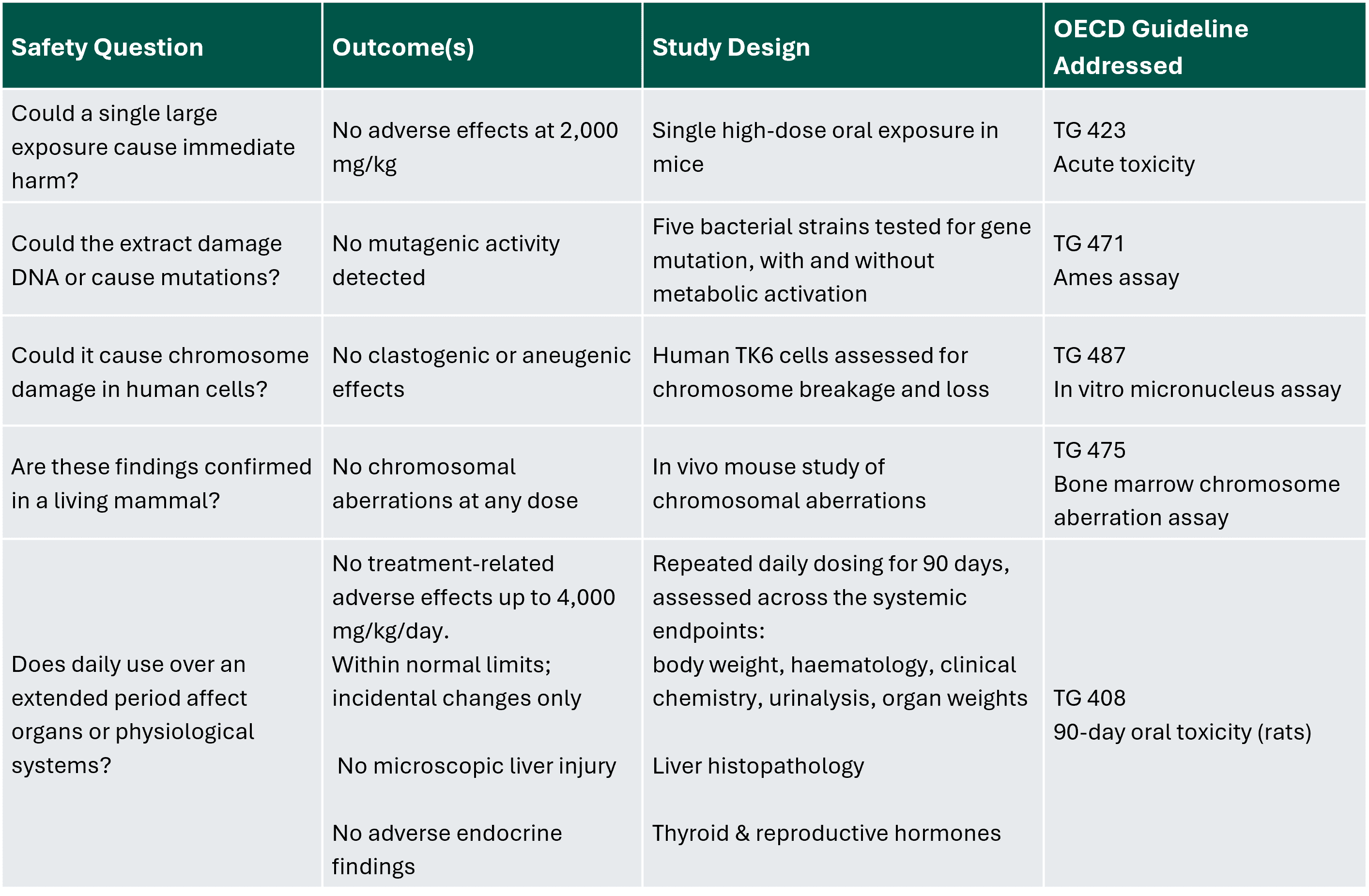
For example, in the recent Summan et al.1 90-day study, an Ashwagandha root-and-leaf extract was administered daily at doses up to 4,000 mg/kg body weight, providing a safety margin 19 times the standard dose of 125mg. No treatment-related adverse effects were observed at any dose tested, establishing the highest tested dose as the No Observed Adverse Effect Level (NOAEL).
Understanding Safety Assessments
In the food and dietary supplement industry, understanding how risks to health are identified, evaluated and managed protects consumers and ensures regulatory compliance.
Risk assessment is a stepwise process used to identify potential hazards and adverse health effects. By completion of a safety assessment, an evidence-based risk analysis of an ingredient can be provided.
Rather than relying on a single study, regulators expect evidence accumulated from several research studies. Each study is designed to answer a different safety question such as would a single large exposure cause harm? would it damage DNA? would daily use affect organs or physiological systems over time?
A battery of genotoxicity tests examined whether a standardised ashwagandha root-and-leaf extract could cause mutations, chromosome damage or other genetic changes to identify potential for long-term health concerns1. The authors concluded there was no evidence of toxicity or genotoxicity observed under the test conditions1 (Table 2).
Table 2. OECD-Compliant Toxicology Assessment for an Ashwagandha Root-and-Leaf Extract1
Regulatory Relevance
The publication of a comprehensive OECD-compliant safety package provides regulators with a standardised toxicological dataset to support the independent assessment of ashwagandha root-and-leaf extract.
In addition to the studies summarised in Table 1, the recent Summan et al.1 contributes evidence in several areas that have been central to current regulatory evaluations, including liver safety, endocrine-related effects, and genotoxicity.
While regulatory decisions are informed by multiple lines of evidence, the availability of these data helps address a longstanding gap in the safety dossier for root-and-leaf ashwagandha preparations and strengthens the overall evidence base available for regulatory review.
Addressing Liver-Safety
Recent regulatory scrutiny of ashwagandha has been driven in part by case reports of liver injury associated with a range of ashwagandha-containing products.
While case reports can help identify potential safety signals, they do not establish causality or isolate the contribution of a specific ingredient or extract to the health concern.
Summan et al.1 who conducted an oral toxicity study under controlled conditions found no evidence of treatment-related liver pathology following administration of an ashwagandha root-and-leaf extract, including at the highest dose evaluated (4,000 mg/kg/day) 1.
In addition, liver histology remained normal and key liver biomarkers (ALT, AST and ALP) showed no evidence of hepatotoxicity1. These findings provide a controlled toxicological dataset that can be considered alongside clinical and real-world evidence when evaluating liver safety.
The US National Institutes of Health has noted that causality in reported cases remains uncertain, citing product adulteration, mislabelling and co-ingestion of other supplements as plausible contributing factors13. These findings, taken together, underscore the importance of using fully characterised, standardised extracts evaluated under controlled conditions when assessing ingredient-level liver safety.
In Summary
As regulatory scrutiny of ashwagandha continues to evolve, the availability of high-quality safety data is increasingly important.
The recent OECD- and GLP-compliant safety assessment of a fully characterised root-and-leaf ashwagandha extract1 provides a robust toxicological dataset, demonstrating no genotoxicity, no treatment-related adverse effects in a 90-day study, normal liver findings and no adverse endocrine effects under the conditions tested.
Importantly, these findings are consistent with the broader clinical evidence showing that standardised ashwagandha extracts are generally well tolerated.
Together, the data highlight the importance of evaluating fully characterised extracts using internationally recognised methodologies to support evidence-based regulatory assessment and informed safety conclusions.