The Role of hydration in the Body
The human body is composed of approximately 55 – 60% water, and it constitutes 95% of the eyes, 83% of blood, 75% of muscles and the brain, 22% of bones. This water is distributed between intracellular fluid (ICF), which makes up about two-thirds of the body’s water, and extracellular fluid (ECF), which constitutes the remaining one-third.
Water moves between the ICF and ECF by osmosis, which is crucial for enabling cellular function and transport of nutrients.
Water has several vital functions in the body, such as acting as a catalyst, lubricating and cushioning tissues, and regulating temperature. It also helps deliver oxygen around the body, facilitates saliva production, and enables the brain to make hormones and neurotransmitters to transport signals around the body.
Hydration and Exercise Performance
Optimal hydration is critical for maintaining good performance during exercise, maximising heat transfer, maintaining mood, and facilitating post-exercise recovery1.
Water is not stored in the body in dedicated reserves, instead water levels are regulated through constant intake and output. Water balance in the body is influenced by factors such as exercise, climate, and nutrition.
Increased physical activity results in more water being lost through perspiration, making it crucial to drink extra fluids to stay hydrated. Therefore, consistent and sufficient fluid intake is vital for meeting the body’s hydration requirements 1.
Dehydration occurs when the body loses water, with losses of greater than 2%2. Being thirsty means the body is already in a state of dehydration3.
Depending on the amount of body fluid lost, dehydration can be mild, moderate, or severe. For instance, dehydration can lead to impaired concentration, increased reaction time, and anxiety, all of which negatively impact exercise performance and recovery4,5.
Research indicates that nearly 71% of adults do not meet the recommended daily fluid intake guidelines6. People who exercise, whether recreational or competitive, often do not adequately replenish fluids lost during exercise3.
This condition, known as Exercise-Induced Dehydration (EID), can be estimated by measuring body mass loss during exercise, which is also known as a person’s Sweat Rate7.
Sweat rate can significantly differ between individuals and even within the same individual under different conditions8. Factors such as environmental temperature, exercise intensity, and individual physiology can affect sweat rate8.
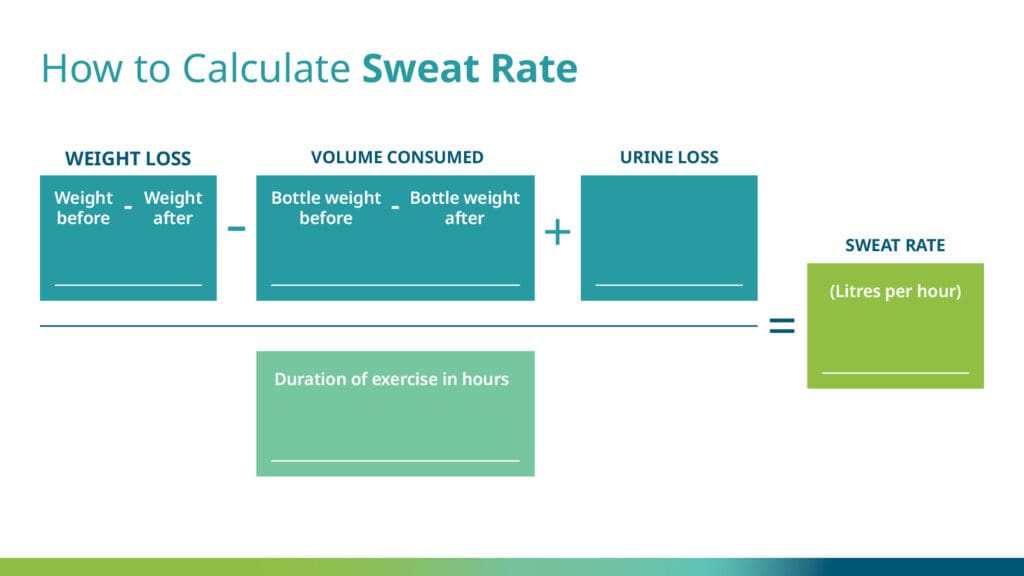
Monitoring sweat rate helps individuals, especially athletes, to know their hydration requirements and tailor their fluid intake to optimise performance and prevent dehydration. To calculate Sweat Rate, the following factors need to be measured – weight loss, volume of fluids consumed, urine loss and the duration of exercise – as shown in the following diagram9.
Hydrating Before, During, and After Exercise
Starting exercise in a hydrated state is essential10. Indicators such as thirst, body weight, and urine colour can help monitor hydration status.
The type of fluids consumed before, during, and after during exercise significantly influences hydration and the body’s ability to absorb water efficiently1,11.
By drinking too much water due to exercise, sodium can be depleted from the body, which is known as Exercise-Associated Hyponatremia (EAH). Causes of EAH is usually by individual sweat loss, excessive intake of hypotonic fluids, and hormonal imbalances, which occur more frequently at longer competitive distances.
However, EAH has been reported in non-endurance sports, such as rowing, shorter races, team sports, and yoga12. EAH, if left untreated or inadequately treated, leads to individuals experiencing altered mental status, seizures, and even coma12.
For recreational exercise, there is no need to overconsume fluids before activity, but keeping hydrated is important.
Pre-hydrating with fluids, in addition to normal meals and fluid intake, should start at least several hours before exercise. The American College of Sports Medicine (ACSM) recommend drinking 500ml of fluid or, going by body weight, 5 – 7ml of fluids per kilogram of body weight1,11.
Including hydrating foods like fruit or fruit juice in pre-activity meals can also help.
The goal during exercise is to prevent a 2% loss of body mass. Fluids consumed should approximately replace sweat volume losses, avoiding both under- and over-consumption.
Thirst may be delayed, so it can be helpful to calculate personal sweat rates to develop a hydration strategy based on an individual’s needs13. Fluids should be cooler than ambient temperature and readily available to allow adequate volumes to be ingested with ease and with minimal disruption to exercise1,11.
During intense exercise lasting longer than 1h, carbohydrates should be ingested at a rate of 30 – 60 grams per hour to delay fatigue and, hence, sustain performance. This rate can be achieved by drinking 0.5 – 1l per hour of fluids containing 6% – 8% carbohydrates1. Adding sodium (0.5 – 0.7g /l of fluid) is recommended as it may promote fluid retention and possibly prevent hyponatremia in individuals who drink excessive amounts of fluid1,11.
Post exercise, the goal is to replenish fluids and sodium losses which improve recovery, reduce hypohydration symptoms, and decrease post-exercise fatigue.
Individuals needing fast and complete recovery from excessive dehydration can drink approximately 1.5l of fluid per kilogram of body weight lost1,9. Whereas individuals capable of recovering over an extended period can rehydrate by consuming normal meals and fluids if lost sodium is replaced.
Importance of a Personalised Hydration Plan
Fluid loss is directly related to body mass, with the body losing approximately 0.4 – 0.5ml of water per kg of body mass per hour.
Without exercise, the recommended water intake is 30 – 40ml per kg of body mass, equating to 2.1 – 2.5l per day14. However, a universal recommendation for rehydration is challenging due to individual variations in daily water intake, sweat rate, and gastrointestinal tolerance.
Given the importance of hydration before, during, and after exercise and the tendency for the body to become dehydrated, an individualized hydration plan is recommended3.
A personalized hydration plan supports fluid intake and successfully optimizes hydration status, regardless of environmental conditions and supports recovery. Additionally, tailored hydration plans have the potential to improve anaerobic power, attention and awareness, and heart rate recovery time15.
Summary
The human body relies on water for essential processes such as nutrient transport, temperature regulation, and cellular function. During exercise, maintaining optimal hydration is crucial to prevent performance impairments and facilitate recovery.
Research highlights that even mild dehydration can significantly impact exercise performance, leading to negative effects on mood, cognitive function and physical outcomes.
Individuals often fail to replenish fluids adequately, and their fluid needs can vary significantly. This emphasizes the need for personalized hydration strategies which consider individual sweat rates, exercise intensity and duration, environmental conditions, and personal tolerance.
Monitoring hydration status through indicators like body weight and urine color, and consuming appropriate fluids before, during, and after exercise, are key components of such a plan.
To read about why keeping hydrated is important for people’s health and wellbeing, click here.