

Aisling Aherne, PhD RNutr FAfN FIFST

Aisling Aherne, PhD RNutr FAfN FIFST

Contributor

Senior Nutrition Science Manager at the KHNI
Go To Contributor's Articles

Aisling is responsible for managing the Kerry Health and Nutrition Institute (KHNI).  Her work centres on ensuring the scientific integrity of KHNI’s content and translating complex nutrition science into clear, actionable, evidence‑based guidance.

Aisling has more than two decades of experience spanning nutritional biochemistry, human health, science communications, and the interface between nutrition science and regulations.  She holds a PhD in Nutritional Biochemistry and a BSc in Nutritional Sciences from University College Cork.

Aisling is a Registered Nutritionist (RNutr) with the Association for Nutrition, a Fellow of the Association for Nutrition (FAfN), a Fellow of the Institute of Food Science and Technology (FIFST), and a Chartered Scientist (CSci)—credentials that reflect her sustained contributions to evidence generation, scientific governance, and professional standards in nutrition science.

She has held multiple leadership roles across industry and professional bodies, including serving as current Chair of Nutritionists in Industry and previously as Chair of the Food Drink Ireland Public Affairs Group.  In addition, Aisling is an Accredited Menopause Specialist supporting evidence‑based approaches to midlife women’s health.


post-imgpost-img

PMOS: The New Name for PCOS

For decades, polycystic ovary syndrome (PCOS) has been defined primarily as a reproductive disorder characterised by the presence of two out of these three features – irregular cycles, hyperandrogenism and/or polycystic ovarian morphology1-3. However, a growing body of evidence shows that PCOS is fundamentally a metabolic endocrine condition with reproductive consequences, not the other way…

post-imgpost-img

Megatrends Shaping Tomorrow’s Food

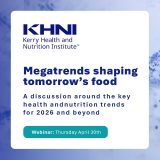
  On 30 April 2026, the Kerry Health & Nutrition Institute (KHNI) hosted an expert scientific webinar on Megatrends Shaping Tomorrow’s Food.  The panel featured the KHNI Scientific Advisory Council: Professor Imed Gallouzi, Dr Lisa Ryan and Professor Martin Bloem. A central theme was longevity—defined not simply as living longer, but as enabling people to…

post-imgpost-img

Understanding Nutrition Research Study Designs

Nutrition is inherently multidisciplinary, drawing from the physical sciences, medicine, public health, psychology, sociology and increasingly, planetary health1. Therefore, nutrition science research is essential for advancing our understanding of human health and supporting evidence based decision making. Research in this space aims to clarify how nutrients, bioactives and other food components influence health, inform dietary…

post-imgpost-img

GLP-1 Drugs: Bridging Satiety, Nutrition, and Innovation

Globally, there are approximately 2.1 billion adults who currently are overweight or have obesity.  It is forecast that this will substantially rise to around 3.2 billion by 2050 – accounting for almost 60% of the adult population1. This highlights that traditional approaches to curbing the prevalence of overweight and obesity have had limited success.  Immediate…

post-imgpost-img

Unlocking Elderberry’s Potential: From Immunity to Innovation

The elderberry plant, Sambucus nigra L., possesses a rich history, deeply embedded in traditional medicine and folklore across continents for centuries1, 2.  Various parts of the plant, including the bark, leaves, flowers, and berries, were utilised by ancient and native cultures for a wide array of medicinal and practical applications. This long history as a…

post-imgpost-img

Hydration and Exercise: Unlocking Full Potential

The role of hydration in the body The human body is composed of approximately 55 – 60% water, and it constitutes 95% of the eyes, 83% of blood, 75% of muscles and the brain, 22% of bones.  This water is distributed between intracellular fluid (ICF), which makes up about two-thirds of the body’s water, and…